Williamsburg, Brooklyn, used to be the neighborhood centered around Broadway. Like its namesake in Manhattan, Broadway is a long, straight boulevard. It leads straight to the Williamsburg Bridge and passage over the East River to Manhattan. In the late 1950s, Williamsburg was devastated by the construction of the Brooklyn-Queens Expresswway (BQE), which cut right through Broadway on a north-south vector, and thus divided the entire neighborhood in half. While the eastern half of Williamsburg managed to survive this butchery, the western half -- the isolated stretch that lay between the BQE and the East River -- was virtually ruined and almost totally abandoned. For decades, the only people who lived on "the wrong side" of the BQE were poor immigrants, mostly from Poland, Italy and Puerto Rico.
In the mid-1990s, as the result of rising rents in Manhattan and the convenience of the "L" subway line, which connects Williamsburg with the Lower East Side, this lonely and very polluted area started to attract all kinds of artists, musicians and hipsters in search of cheap housing. We ourselves lived there between 1997 and 1998.
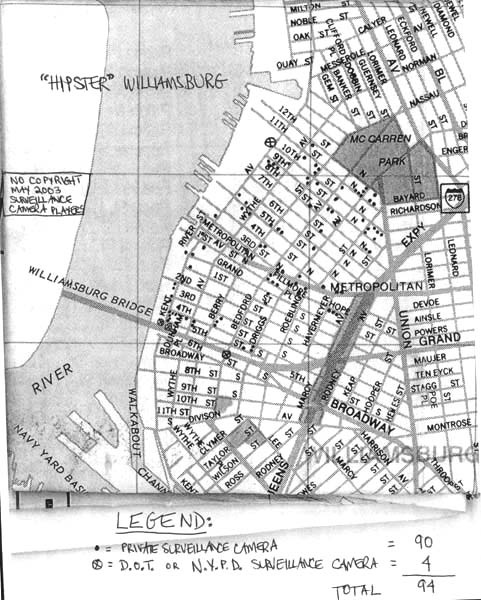
In early May 2003, we made a map of surveillance cameras operating in public. The results were striking. Though small, the area contained a relatively large number of surveillance cameras, at least compared to the other places we'd mapped. There were a total of 94 in Williamsburg: 90 installed on privately owned buildings; and four installed on buildings owned by the City of New York. Remarkably, there were no cameras in operation along Bedford Avenue between 12th Street and Metropolitan Avenue, that is, in the heart of the "hip" area. With a handful of exceptions (i.e., the cameras installed on brand-new buildings), the vast majority of the privately owned cameras are installed on or near old-style commercial loading docks and are obviously used to discourage or record incidences of theft. Given the bulk or "raw" nature of the commodities involved (sugar and spices, oil and gas, iron and other construction materials), it seems likely that the type of crime being fought or perpetrated here is organized crime, that is, Mafia-related activities. In some places, especially along Kent Avenue, where one finds elegant Italian restaurants located next-door to garbage-carting companies, the scene looks like something right out of The Sopranos.
Though one can't be sure, it appears that organized crime (of one sort or another) also plays an important role in at least one of Williamsburg's four city-owned surveillance cameras. Located atop a pole erected at the intersection of 10th Street and Kent Avenue, this camera appears to be operated by the Department of Transportation (DOT), which controls several lots and buildings in the area. In the case of the 10th Street camera, perhaps the DOT is trying to stop the mob from stealing cars from the city's impound lot, which is located on the west-side of the intersection. But then why do the cords coming out of this camera lead in the opposite direction, that is, away from the impound lot, across (and over!) the street and into an apparently unused building? Perhaps this camera is actually being used by the mob to watch the DOT, and not the reverse.
One other city-owned camera merits description. Clearly operated by the New York Police Department and not the DOT, this camera is on the Williamsburg Bridge at precisely the point that it crosses over Bedford Avenue, which means it can secretly observe activity (the movements and identities of pedestrians, bicyclists and automobile drivers) on the bridge itself and on Bedford Avenue as far north as Metropolitan Avenue. The camera itself is hidden inside an "innocent-looking" globe-shaped housing, that is, intentionally designed to look like (be confused with) an ornament or a light. Unaccompanied by a sign that warns potential criminals and/or re-assures potential crime-victims that a high-powered surveillance camera is in operation, it isn't capable of producing any sort "deterrent" effect on crime. The only thing it is good for is spying.
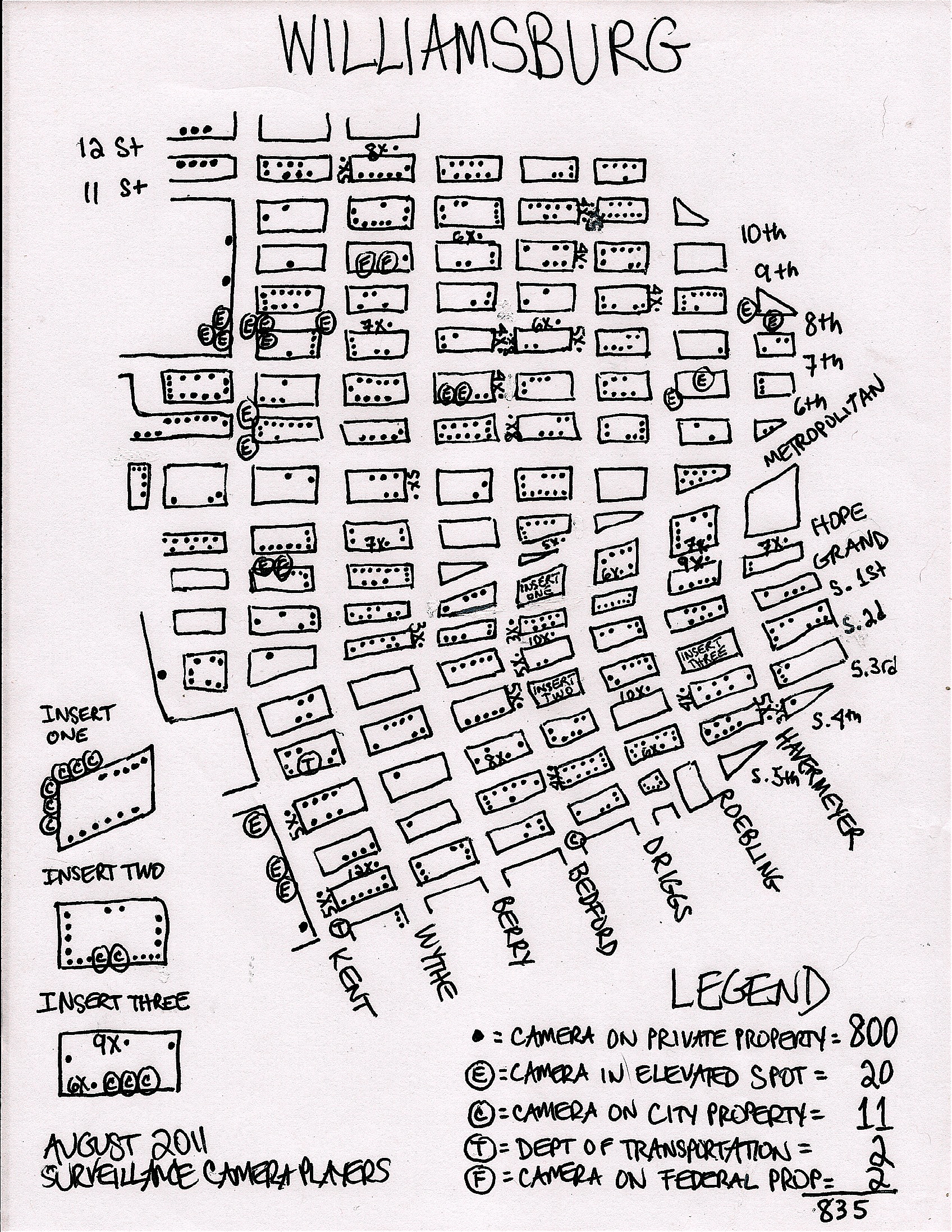
-- May 2003In August 2011, we returned to Williamsburg and mapped it out for a second time. But alas the Williamsburg of today is almost a completely different place from the Williamsburg of 2003. The gentrification of the area, begun in the mid-1990s, has almost been completed. The cement factories and waste-transfer sites have been shut down. Many of the old brick warehouses have been demolished, and have been replaced by condos, luxury apartment buildings, and steel-and-glass high-rises. The rents are very high, and the Latinos and Puerto Ricans who used to live in the area south of Grand Street have been displaced. The entire place is now almost completely filled with yuppies, rich tourists, hipster douchebags and students from affluent families.
Not surprisingly, the new super-gentrified Williamsburg is also packed with publicly installed surveillance cameras. According to our research, where there once were only 94 cameras (90 on private property and four on city-owned buildings and street poles) there are now a staggering 835 cameras (800 on private property, 15 on buildings in which either federal or city business is done, and 20 in elevated positions). That means, over the course of the last eight years, the number of cameras in Williamsburg has increased nine hundred percent. Indeed, there are now so many cameras in Williamsburg that our map required three inserts to portray the complete picture.
The making of this particular map, which took 10.5 solid hours of walking, looking and notating, has reminded us that our objections to the video-surveillance of public places arent simply political (the threat to civil liberties), behavorial (incitement to conformism) and economic (the waste of money). We object to surveillance for social reasons, too: we dont like to be around the people who "don't mind" or even like to be watched by surveillance cameras. They creep us out.
-- August 2011By e-mail SCP@notbored.org